
Beyond Naive Search: Moving to RAG 2.0 and Knowledge Graph Integration
You’ve watched your RAG prototype ace the demo, then collapse in production. Multi-hop questions return confident nonsense. Compliance teams flag AI-generated answers that sound perfect but cite relationships that don’t exist. The vector-only architecture that felt like magic in the lab is now costing you real money in failed deployments.
The fix isn’t another embedding model. It’s a fundamental architectural shift: RAG 2.0 with Knowledge Graph integration. By 2026, the industry consensus is clear—flat vector stores alone are an anti-pattern for enterprise AI. Teams that bolt structured, relationship-aware retrieval onto their pipelines are seeing 40% hallucination drops and 340% accuracy gains on complex queries, a trajectory confirmed by Microsoft Research’s GraphRAG project which demonstrated that graph-based community summaries dramatically outperform naive vector retrieval on global sensemaking tasks. This isn’t incremental improvement. It’s a different category of system. If you’re still running “search and paste” retrieval, consider this your wake-up call.
TL;DR: The RAG Evolution Blueprint
- 40% Hallucination Reduction: GraphRAG grounds answers in deterministic entity relationships, slashing fabrication rates across production deployments.
- 340% Accuracy Spike: Multi-hop queries see massive precision gains when traversing structured knowledge graphs instead of flat vector spaces.
- Dual-Index Standard: 2026 production systems run vector databases alongside graph databases in parallel—neither alone is sufficient.
- Death of Flat Silos: Discarding document relationships during chunking is now a recognized architectural anti-pattern.
- Agentic Routing: LLM routers dynamically choose between vector similarity and Cypher-based graph traversal per query.
- Automated Triple Extraction: Specialized models continuously extract semantic triples from unstructured data streams into live knowledge graphs.
- Sub-second Latency Maintained: Optimized hybrid retrieval holds strict SLA compliance despite added graph computation overhead.
Mini-Glossary: The New Retrieval Vocabulary
- Semantic Triple: A subject-predicate-object structure (e.g., Acme Corp → ACQUIRED → Globex) that explicitly defines the relationship between two entities in a knowledge graph.
- Vector-Graph Hybrid: An architecture combining semantic similarity search with structured graph traversal to maximize both recall and precision.
- Multi-hop Retrieval: Answering complex queries by connecting disparate facts across multiple documents or database nodes in sequence.
- Information Extraction (IE): The pipeline phase where language models identify entities and relationships from raw text to populate a knowledge graph.
- Graph Traversal: Navigating connected nodes and edges algorithmically to uncover dependencies and hierarchical context invisible to vector search.
The Failure of Naive RAG: Why Top-K Isn’t Enough
Think of naive RAG as a librarian who finds books with matching keywords but can’t read the org chart. Semantic similarity retrieves related text—not correct context. For simple chatbots, this feels like magic. For enterprise workflows requiring multi-step reasoning, it’s a ticking time bomb.
The core problem: when a question requires synthesizing facts scattered across documents, top-K retrieval grabs chunks that look relevant but share no logical connection. A financial auditor asking how Supplier A’s delay impacts Facility B gets chunks mentioning both—but no causal chain linking them. The “Lost in the Middle” phenomenon compounds this: LLMs struggle to weigh disconnected paragraphs, burying critical facts in noise. Vector databases excel at surface matching but violently discard the explicit links that give enterprise data its meaning. You end up with a system that’s confidently wrong at scale — a failure mode that only becomes more expensive as deployment widens.
The Vector Bottleneck in Practice
Embeddings compress semantic meaning into geometric proximity while destroying relational data. Words with similar meanings cluster together, but the hierarchical logic connecting them vanishes. This prevents language models from executing multi-step reasoning effectively.
Picture a massive legacy codebase. A developer asks how modifying the authentication module impacts the downstream shipping API. A vector database retrieves chunks mentioning “authentication” and “shipping”—but cannot trace the actual function calls or inheritance structures linking them. The system returns mathematically similar text while completely ignoring the software’s operational reality. Flat agents fail because they lack a topological map of the data. Engineers end up manually stitching context together, defeating the purpose of automation. This bottleneck is why agentic workflow architectures have become essential—they compensate for what vectors structurally cannot provide.
Semantic Drift: When Similarity Lies
Semantic drift strikes when highly similar text chunks contain contradictory operational facts. Two contracts might share identical boilerplate but feature vastly different liability clauses. Vector similarity cannot distinguish structural identicality from critical factual divergence.
This becomes dangerous in regulated domains. If a doctor queries a patient’s drug reaction, naive RAG might retrieve a different patient’s record with similar symptoms—because the embedding vectors align in high-dimensional space. The system prioritizes linguistic resemblance over factual precision. Metadata filtering helps, but it’s a band-aid. True resolution requires deterministic retrieval pathways where relevance isn’t defined solely by mathematical distance. When it is, semantic drift inevitably pollutes the context window, leading to compromised decisions in exactly the scenarios where accuracy matters most.
The Real Cost of Fluent Hallucinations
Fluent hallucinations are naive RAG’s deadliest failure mode. The retrieved context is semantically relevant but structurally disconnected, so the LLM generates plausible, grammatically perfect, yet entirely fabricated answers. These silent failures bypass every human review instinct.
The system retrieves relevant text. The model confidently produces a synthesized lie. In a supply chain scenario, if an LLM incorrectly links a delayed shipment from Supplier A to a production halt at Facility B—because both appeared in similar contexts—the resulting business decision could be catastrophic. The financial impact of acting on a fluent hallucination dwarfs the cost of implementing robust retrieval. Enterprises now recognize that mitigating this risk means injecting hard, deterministic logic into the retrieval pipeline before generation begins. As we explored in our analysis of on-chain accountability standards for autonomous agents, this is a compliance imperative, not a nice-to-have.
Defining RAG 2.0: From Retrieval to Reasoning
RAG 2.0 replaces “search and paste” with active, structured reasoning. Instead of a linear pipeline—embed, search, generate—modern architectures use iterative reasoning loops where the system retrieves data, evaluates completeness, and autonomously formulates follow-up queries to fill gaps.
This shift demands hybrid retrieval mechanisms that cross-reference unstructured text with structured databases in real-time. The system doesn’t passively accept top-K results. It interrogates them. A robust orchestration layer—typically built on frameworks supporting cyclic execution—enables the AI to treat retrieval as a multi-step reasoning problem. Organizations deploying this architecture finally get AI agents capable of handling ambiguous enterprise queries without constant human intervention or manual prompt engineering. The payoff: dramatically fewer hallucinations and dramatically more useful answers.
The Dual-Index Architecture
The dual-index architecture runs a vector database and knowledge graph in parallel. This captures both the semantic nuance of unstructured text and the explicit, deterministic relationships required for complex logical operations. Think of it as giving your AI both intuition and a map.
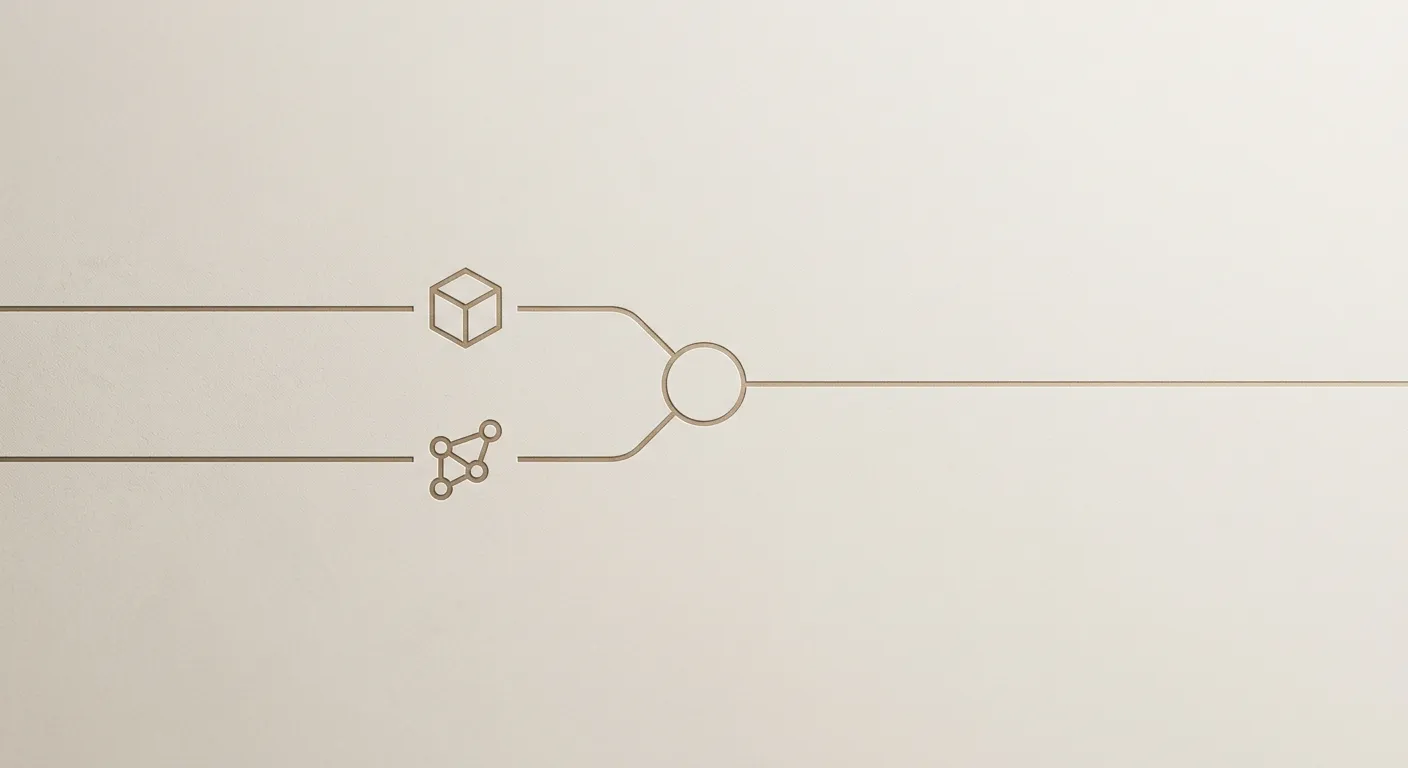
During ingestion, documents are simultaneously chunked for vector embeddings and parsed to generate semantic triples that populate the graph. At runtime, a query routing agent analyzes the user’s prompt. Broad thematic questions hit the vector index. Dependency-tracing or entity-aggregation questions get translated into Cypher queries for the graph. Often, optimal responses merge results from both indexes, providing the LLM with a multi-dimensional context window. This dual-index pattern has become the dominant engineering approach for production AI in 2026, as Neo4j’s GraphRAG documentation illustrates with its reference architectures for combining property graphs with vector retrieval.
Agentic Workflows Replace Static Pipelines
Agentic workflows replace single-shot retrieval with autonomous reasoning loops. The AI agent formulates a plan, retrieves initial context, evaluates it against the original query, and triggers subsequent searches if critical information is missing.
Consider summarizing a new vendor’s compliance risks. An agentic system first queries the knowledge graph for all contracts associated with that vendor. It evaluates the retrieved nodes, realizes it needs specific clauses, and autonomously generates a secondary vector search targeting those exact document chunks. This loop continues until the agent determines it has sufficient, cross-validated context. By decoupling retrieval from generation, agentic workflows ensure the LLM is grounded in exhaustive enterprise data—not whatever happened to land in the top-K results.
Breaking Free From Flat Data Silos
Flat vector silos trap enterprise knowledge in disconnected chunks. Legal rulings cite previous cases. Codebase classes inherit from one another. Medical symptoms connect to genetic histories. Classic RAG chunking violently severs every one of these connections.
Moving beyond silos means preserving metadata and structural hierarchy during ingestion. Engineers must implement bidirectional linking: every embedded chunk retains pointers to its parent document, sibling chunks, and referenced external entities. This structural preservation lets the retrieval engine reconstruct original context dynamically, eliminating the blind spots created by isolated vector storage. The goal isn’t just better search—it’s a cohesive, interconnected web of operational intelligence that language models can traverse systematically.
The Knowledge Graph Advantage: Structure Over Chaos
Knowledge Graphs provide the deterministic “world model” that vector embeddings inherently lack. Every person, product, and concept becomes a distinct node connected by clearly defined relationship edges. When an LLM generates an answer based on graph traversal, the system provides exact provenance—the specific path through the graph. This explainability is non-negotiable in regulated industries.
Unstructured data is chaotic. LLMs parse chaos well but cannot reliably deduce multi-layered relationships without explicit guidance. A Knowledge Graph imposes order by translating raw text into a standardized ontology with enforced schema constraints. This structure is mandatory when you need fast joins across connected datasets. In finance and healthcare, where explainable AI requirements are tightening quarterly — driven by frameworks like the EU AI Act’s transparency obligations — the ability to show why an answer was generated—not just that it was generated—separates deployable systems from expensive experiments.
Entity Mapping for Deterministic Accuracy
Entity mapping transforms ambiguous text into hard, queryable data points. The sentence “Acme Corp acquired Globex in 2025” becomes (Acme Corp)-[ACQUIRED]->(Globex {year: 2025}). Once mapped, this relationship is immutable and instantly retrievable.
When a user asks about Acme Corp’s acquisitions, the system doesn’t guess which chunks might be relevant—it queries the graph for all outgoing [ACQUIRED] edges from the Acme Corp node. This eliminates semantic drift entirely. Entity mapping also enables continuous deduplication and resolution: “Acme Corporation,” “Acme Corp,” and “Acme” all resolve to the same node. Specialized NLP models handle extraction at scale, identifying semantic triples from raw text and feeding them into the graph continuously. The result is a retrieval layer that operates on facts, not probabilities.
GraphRAG Solves Multi-hop Queries
Multi-hop queries connect disparate facts across multiple documents to form cohesive conclusions. GraphRAG turns retrieval into a traversal problem, physically walking the graph’s edges to connect entities that share zero semantic similarity.

Consider: “Which vendors supply both Component A and Component B, and have had a compliance incident in the last 18 months?” Standard RAG finds chunks about Component A or compliance but cannot intersect them logically. GraphRAG locates the Component A and Component B nodes, traverses [SUPPLIED_BY] edges to find common vendor nodes, then filters by connected [HAS_INCIDENT] nodes with recent date properties. The LLM receives a perfectly structured, relationship-aware context block. No hallucination required—the answer is already assembled.
Cypher Queries vs. Vector Search: Scalpel vs. Net
Cypher provides surgical precision. MATCH (v:Vendor)-[:SUPPLIES]->(c:Component) WHERE c.type = 'Critical' RETURN v.name executes instantly and returns exactly the requested entities. Vector search casts a wide net, calculating distances between high-dimensional arrays—computationally expensive and imprecise for exact matching.
However, Cypher is rigid: if the exact pattern doesn’t exist, it returns nothing. This is precisely why the hybrid approach dominates in 2026. Systems use Cypher for strict structural traversal and fall back to vector search for linguistic variations and fuzzy conceptual matching within node properties. The routing layer decides per-query, giving you the scalpel when you need precision and the net when you need coverage. Neither tool alone is sufficient. Together, they cover the full spectrum of enterprise retrieval needs.
Comparative Analysis: Vector vs. Graph vs. Hybrid
Selecting the right retrieval architecture dictates the operational ceiling of your AI deployment. Here’s the unvarnished breakdown:
| Dimension | Pure Vector | Pure Graph | Hybrid (RAG 2.0) |
|---|---|---|---|
| Setup Cost | Low | High (ontology design) | Medium-High |
| Multi-hop Accuracy | ~25% | ~90% | ~85-92% |
| Hallucination Rate | High | Very Low | Low |
| Latency | Sub-50ms | 50-200ms | 80-250ms |
| Maintenance Burden | Low | High (schema evolution) | Medium |
| Fuzzy Query Handling | Excellent | Poor | Excellent |
| Explainability | None | Full provenance | Partial-to-Full |
| Best For | Thematic search, FAQ | Compliance, audit trails | Production enterprise AI |
Pure vector is cheap to build but expensive to maintain due to hallucination remediation. Pure graph offers perfect precision but demands massive upfront ontology investment. The hybrid approach delivers the highest ROI by balancing semantic flexibility with deterministic accuracy. For most enterprise teams in 2026, hybrid isn’t the ambitious choice—it’s the only defensible one.
Your next move: Audit your current RAG pipeline for multi-hop failure rates. If accuracy drops below 60% on questions requiring two or more reasoning steps, you have a vector bottleneck. Start by extracting semantic triples from your highest-value document corpus and standing up a parallel graph index. You don’t need to rearchitect everything overnight—but you need to start before your competitors’ AI systems reason circles around yours.