
x402 Protocol: The Payment Primitive Your AI Agents Are Missing
The machine economy has spent years trapped in a brutal contradiction. We have software that can reason, route tasks, scrape data, and orchestrate cloud infrastructure — but when it comes time to pay, it still hits a human checkpoint. A card form. An invoice portal. A prepaid subscription key tied to someone’s billing account.
Let’s be honest: that is not a minor UX flaw. It is the core bottleneck preventing machine-to-machine commerce from scaling beyond demos.
The x402 Protocol is a serious attempt to remove that bottleneck by turning payment into a native part of the HTTP request itself. Coinbase describes it as an open payment protocol that revives HTTP 402 Payment Required — allowing both human and machine clients to pay programmatically, without accounts, sessions, or complex authentication. The protocol repository goes further: x402 is HTTP-native, network-agnostic, trust-minimizing, and explicitly designed to avoid dependence on a single party.
This is not another developer payment wrapper. It is an ideological challenge to the current internet business model: closed billing stacks and API-key gatekeeping versus a permissionless fabric where software can discover, price, buy, and sell services autonomously.
Why Agentic Workflows Still Hit a Wall
The industry loves to talk about autonomous agents, but most so-called agentic workflows today are only partially autonomous. They can reason and route tasks — yet they still depend on human-created accounts, human-managed budgets, and human-approved vendors. They do not participate in an economy. They operate inside software cages.
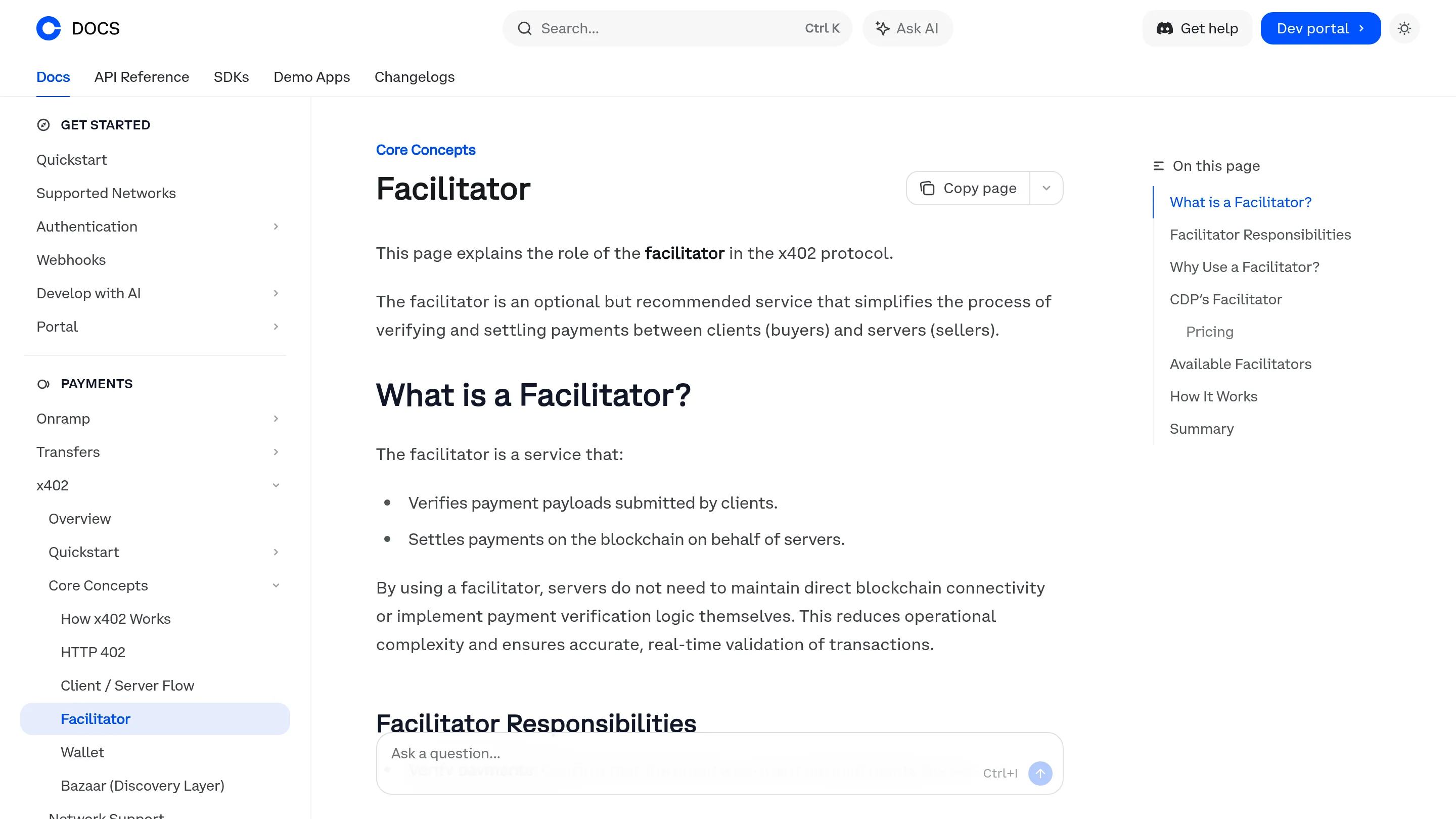
x402 changes the design space because it makes value transfer look like infrastructure rather than business-process overhead. The flow is elegant: a service returns a 402 Payment Required response with terms, the client signs payment, a facilitator verifies and settles, and the same HTTP flow continues. As Coinbase argues in their CoinGecko launch write-up, subscriptions and API keys map poorly to autonomous software that needs reliable data access on a per-request basis.
For B2B builders, this unlocks a more capital-efficient architecture:
- Monetize at the endpoint level instead of forcing everything into subscription bundles
- Let agents buy only what they need — data, inference, browser time, compute
- Remove manual onboarding for low-value, high-frequency transactions
- Turn APIs into liquid, machine-readable commercial surfaces
That is the shift from SaaS as a seat-based license to services as programmable economic primitives.
The Real Battle: Open Rails vs. Walled Gardens
Here is the trap most builders miss. The fight around x402 is not technical first — it is political economy.
Legacy rails fail exactly where machine commerce begins. Card networks and invoice billing are structurally poor fits for micropayments. A model that works for $99/month SaaS does not work for one cent of data or 300 milliseconds of browser automation purchased by an autonomous process.
API keys are operational liabilities — secret management overhead, pre-registration requirements, and human account provisioning entangled with runtime execution. And centralized Agent-as-a-Service vendors can throttle, deplatform, or reprice access at will.
The x402 story resonates beyond payments because it determines whether the agentic economy will be owned by protocol layers or by managed intermediaries.
Architecture That Matters: Identity, Settlement, Discovery
Layered machine identity. x402 defines clear roles — client, resource server, and facilitator — supporting composable trust boundaries. Machine identity in this world will be layered: wallet-based authorization at the base, attestation layers for compliance, reputation layers for anti-abuse, and hardware attestations for high-trust environments like decentralized physical infrastructure.
In-band, event-driven payments. The most important conceptual shift is that payments become part of the HTTP conversation. Request, receive 402 pricing terms, sign, retry, receive the resource. This creates the operational basis for per-event monetization and per-query settlement — aligning cost and revenue far more tightly than monthly reconciliation ever could.
LTV:CAC — The Business Case, Stripped Bare
B2B operators should ignore the hype and ask a simpler question: does x402 improve the business?
Traditional API monetization carries hidden acquisition costs: sign-up flows, key provisioning, billing support, fraud handling, failed collections, and the deadweight cost of free-tier freeloaders. x402 compresses that stack. A buyer agent pays on first contact. A seller monetizes without building a full account system. Coinbase’s facilitator pricing shows a free tier up to 1,000 monthly transactions, then $0.001 per transaction — making experimentation economically accessible.
The LTV:CAC upside appears in four places:
- Faster revenue realization — no invoicing cycles
- Lower onboarding friction — wallet plus payment flow replaces account bureaucracy
- Reduced support load — fewer billing portals, password resets, key rotations
- Better price discrimination — sell premium resources per call, not buried in enterprise plans
Real-World Scenarios Already in Motion
Autonomous browser sessions. Browserbase has launched x402 endpoints so agents can purchase hosted browser sessions with USDC on Base — no API keys, no manual onboarding. Agents navigate real pages, interact with real interfaces, and pay for compute autonomously.
Pay-per-query data access. Coinbase’s SQL API integration shows a wallet-bearing agent accessing onchain data instantly at a quoted per-query price — removing the “human billing account” dependency that prevents autonomous strategies from operating end-to-end.
Agent service discovery. x402 Bazaar lets autonomous agents find, test, and pay for compatible services dynamically. Discovery becomes one layer, payment another, reputation another. The marketplace loses its monopoly choke point.
Risks You Cannot Ignore
We have to warn you: once you open machine commerce to autonomous participants, you inherit adversarial internet economics.

Sybil attacks. Any open protocol with low-cost identity creation faces Sybil risk. Malicious agents can spin up wallets, simulate purchase histories, inflate seller rankings, and poison discovery layers. Mitigations include stake-based participation, escrow for fraud-prone interactions, attestation-backed identities, and graph-based reputation scoring.
Oracle failure. If payments trigger on external conditions — sensor events, market prices, shipment confirmations — then oracle security becomes part of your perimeter. A machine could pay on a false maintenance signal or a manipulated commodity price. Require multi-source quorum, deviation thresholds, and dispute windows for high-value flows.
Payment channel congestion. Research shows payment channel networks can suffer congestion attacks that lock capacity at low cost. As transaction frequency scales, attackers will target the liveness assumptions underneath x402.
The good news: x402’s separation of payment, facilitation, and service discovery makes security controls modular rather than monolithic.
What to Build Right Now
Do not wait for the stack to be perfect. Adopt x402 where it is already strongest: metered APIs, agent tooling, data access, and high-frequency service transactions.
- Start with one monetizable endpoint. Wrap a narrow API route in x402 rather than redesigning your whole product.
- Instrument unit economics obsessively. Revenue per request, facilitator cost, support load reduction.
- Treat identity and reputation as first-class layers. Payment alone is not trust.
- Give agents bounded budgets. Approved vendors, spend thresholds, policy envelopes.
- Design for facilitator pluralism. Your architecture should not hard-code dependence on one operator.
Protocol fluency compounds. Teams that learn machine-native pricing and anti-abuse design now will have an edge when agent-to-agent commerce becomes mainstream.
x402 matters because it attacks a foundational contradiction: we built machines that can decide, but not machines that can natively transact. For B2B builders, resolving that contradiction is not philosophical decoration — it is strategy. And the window to build that advantage is open right now.