Blackwell is the New Gold: Turning Your RTX 5090 Setup into a High-Performance AI Node
The NVIDIA RTX 5090, built on the Blackwell architecture, has opened a practical path for individuals and small teams to serve the growing demand for AI compute. This is not a speculative frenzy — it is a measured shift in how consumer-grade hardware supports machine learning workloads, from local inference to participation in decentralized cloud networks. With 32 GB of GDDR7 VRAM, 5th-generation Tensor Cores, and full CUDA compatibility, the RTX 5090 enables deployment as a high-performance AI node without enterprise infrastructure.
This analysis examines the technical and operational realities of configuring an RTX 5090 system for sustained AI workloads, drawing from documented benchmarks, implementation reports, and platform analyses.

TL;DR With Hard Numbers
The RTX 5090 delivers 3,352 AI TOPS — a 2.5× improvement over the RTX 4090 — supported by 32 GB GDDR7 VRAM and 1,792 GB/s bandwidth. At a 575 W TDP, it handles LLM fine-tuning of models up to 20B parameters with efficient FP8 precision via 5th-generation Tensor Cores. Integrated into Dockerized frameworks on platforms such as Fluence and Vast.ai, individual nodes generate revenue through compute-as-a-service while maintaining manageable thermals. Full setups require 1,000 W+ PSUs, robust cooling, and CUDA 13.x tooling, with ROI dependent on regional electricity costs and rental utilization rates above 60%.
Mini Glossary
- Blackwell architecture — NVIDIA’s 2025 GPU design emphasizing enhanced Tensor Cores and GDDR7 memory for mixed AI and graphics workloads.
- 3,352 AI TOPS — Peak AI operations per second for the RTX 5090, primarily achieved through FP8 and INT8 precision.
- 1,792 GB/s bandwidth — Memory throughput provided by the 32 GB GDDR7 subsystem, critical for reducing data-movement bottlenecks in large-model training.
- FP8 performance — Low-precision computing that balances speed and accuracy for inference and fine-tuning tasks.
- Dockerized frameworks — Containerized environments that standardize deployment of CUDA-dependent AI software across heterogeneous nodes.
Architectural Deep-Dive: Why Blackwell Changes the Math
The Blackwell architecture represents a significant evolution in consumer GPU design. At its core sit 21,760 CUDA cores across 192 streaming multiprocessors — a 33% increase over the RTX 4090’s 16,384 — powering 5th-generation Tensor Cores optimized for FP8 workloads.
Memory is where Blackwell truly differentiates. The 32 GB GDDR7 subsystem achieves 1,792 GB/s bandwidth, a 78% uplift over the 4090’s 1,008 GB/s. This eliminates many bottlenecks that plagued previous generations during LLM fine-tuning and large-model inference. NVIDIA also enhanced streaming multiprocessors with better mixed-precision support, making FP8 and FP16 operations exceptionally efficient for PyTorch-accelerated applications.

Reports indicate consistent performance across 24/7 operation when paired with adequate cooling, avoiding the thermal throttling common in earlier high-TDP consumer cards. For decentralized cloud contributors, the bandwidth improvements translate directly to faster model loading and context switching between client workloads — particularly relevant for inference endpoints serving batched requests from multiple concurrent AI services.

Comparative Analysis: RTX 5090 vs. Enterprise Datacenter GPUs
| Specification | RTX 5090 | RTX 4090 | H100 (SXM5) |
|---|---|---|---|
| AI TOPS (FP8) | 3,352 | ~1,340 | ~4,000+ |
| VRAM | 32 GB GDDR7 | 24 GB GDDR6X | 80 GB HBM3 |
| Memory Bandwidth | 1,792 GB/s | 1,008 GB/s | 3,350 GB/s |
| TDP | 575 W | 450 W | 700 W |
| CUDA Cores | 21,760 | 16,384 | 16,896 |
| Best For | LLM fine-tuning, inference, decentralized cloud | General ML, smaller models | Large-scale training, enterprise |
| Approx. Cost (2026) | $1,800–2,200 | $1,200–1,500 | $25,000+ |
Data synthesized from Fluence, Compute Market, and RunPod benchmarks. Actual performance varies by workload and optimization.
The RTX 5090 excels where flexibility and cost-per-token matter more than absolute scale. Its 32 GB GDDR7, while less than the H100’s 80 GB HBM3, proves sufficient for the majority of current open-source models using QLoRA and efficient quantization. At 575 W, it operates within consumer power-delivery limits, whereas datacenter cards require specialized infrastructure. Full CUDA support and seamless PyTorch integration let developers use identical codebases across consumer and enterprise hardware.

The primary trade-off involves multi-tenant isolation. Enterprise solutions offer better partitioning and management features; the RTX 5090 relies on external orchestration and Dockerized frameworks for similar outcomes.
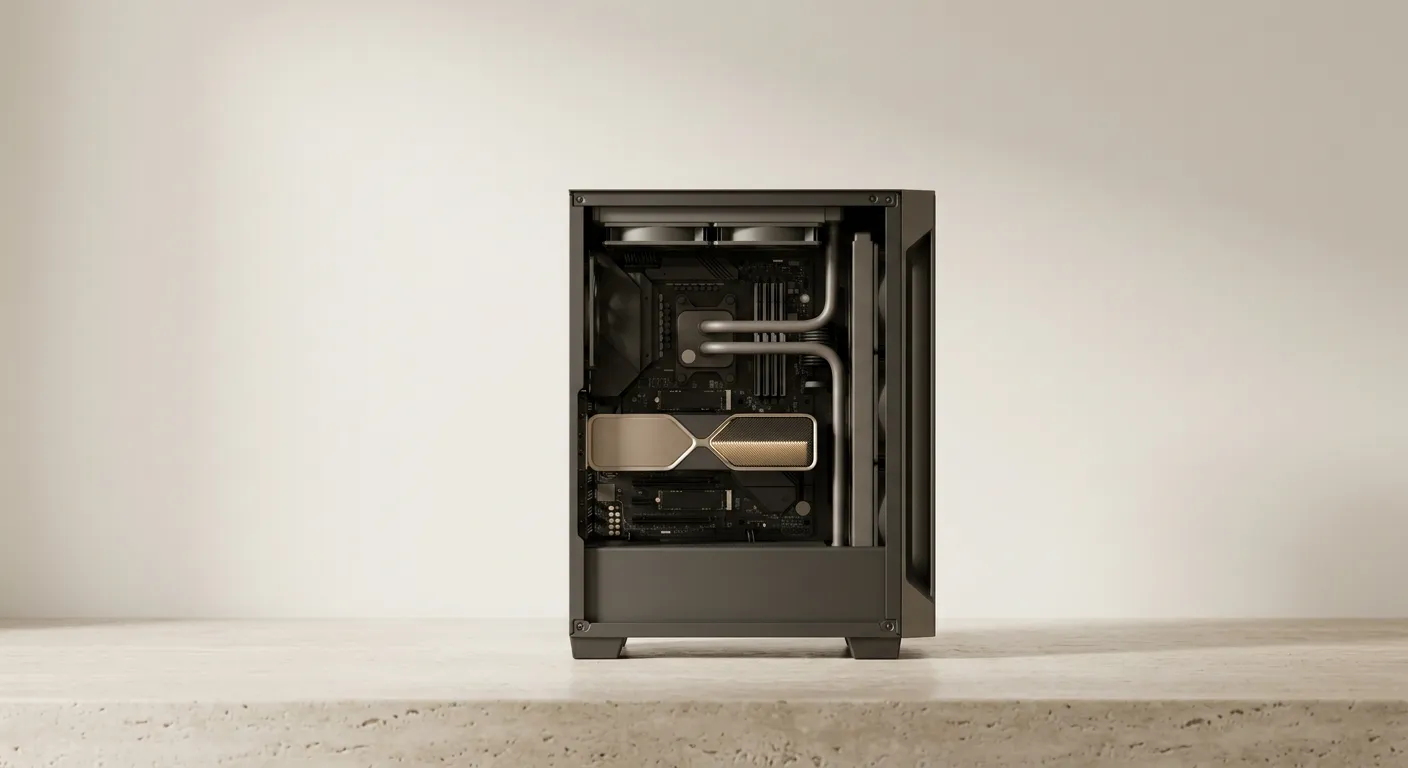
Building the Node: Hardware Beyond the GPU
Constructing a stable RTX 5090 AI node demands attention to supporting components:
- PSU — A minimum 1,000 W 80+ Platinum unit handles the 575 W TDP under sustained load while providing headroom for drives and peripherals.
- Cooling — Custom liquid cooling or high-static-pressure air cooling with multiple 140 mm fans keeps junction temperatures below 75 °C during 24/7 operation.
- Storage — NVMe SSDs with at least 2 TB capacity and high sustained write speeds facilitate rapid dataset loading and checkpointing. Decentralized node operators may need additional storage to cache multiple models.
- System RAM — 64 GB or more prevents CPU-side bottlenecks when running multiple inference endpoints simultaneously.
- CPU — At least 12 cores to manage orchestration overhead from Docker and monitoring tools.
These requirements increase total system cost but remain substantially lower than equivalent enterprise configurations.

The Software Stack: WSL2, Docker, and CUDA 13.x
Windows users have standardized on a WSL2 + Docker + CUDA 13.x stack for RTX 5090 deployments. This combination provides a Linux-compatible environment while maintaining access to host NVIDIA drivers and full GPU acceleration.
Installation begins with enabling WSL2 and the latest CUDA toolkit compatible with Blackwell. Docker Desktop with WSL2 backend enables reproducible environments easily shared across nodes. Resource allocation through Docker Compose ensures fair division of the 32 GB VRAM between containers — whether for inference endpoints, fine-tuning jobs, or monitoring.

Community-maintained Docker images have emerged that optimize for the RTX 5090’s specific capabilities, including automatic detection of GDDR7 memory characteristics and appropriate FP8 precision settings. For Linux-native setups, direct CUDA 13.x installation provides slightly lower overhead, though WSL2 has gained popularity for its integration with Windows development tools.
Monetization: Connecting to Decentralized Compute Networks
Platforms such as Fluence and Vast.ai allow operators to offer RTX 5090 capacity to a global pool of developers requiring flexible AI resources. Setup involves installing platform-specific agents that handle job scheduling, resource reporting, and payment processing, integrating with the local Docker environment to deploy client workloads securely.
The RTX 5090’s combination of 32 GB VRAM and strong FP8 throughput makes it attractive for inference workloads and smaller fine-tuning jobs. Revenue depends on electricity costs, node reputation, and market demand for specific model architectures. Some operators combine local development with opportunistic rental during idle periods.
This model aligns with broader trends toward distributed AI infrastructure. As explored in related discussions on agentic workflows in decentralized ecosystems, such networks enable more resilient and accessible AI development pipelines.
The Economics of 2026: ROI and Power Consumption
The 575 W TDP makes electricity a primary factor in ROI calculations. Continuous operation consumes approximately 414 kWh per month per card, translating to meaningful operational expenses that must be offset by rental income or internal productivity gains.
Acquisition costs have stabilized post-launch, with street prices reflecting strong demand from both gamers and AI enthusiasts — the card is being snapped up as an investment product. Amortized over 2–3 years, per-hour compute cost becomes competitive with certain cloud offerings for bursty or specialized workloads. Utilization rates above 65% appear necessary for positive returns in pure rental scenarios.
As noted in analyses of CAC collapse through autonomous pipeline generation, efficient infrastructure can dramatically improve operational metrics across AI organizations. Operators who combine personal use with marketplace participation often achieve the best overall economics.
Future-Proofing: Scaling from Single Node to Local Cluster
Individual RTX 5090 nodes serve as starting points for broader AI infrastructure. NVLink is unavailable on consumer cards, so clustering relies on standard networking with appropriate job scheduling. Multi-node setups benefit from shared storage and centralized monitoring, while distributed training tools help maximize collective compute capacity.
The Blackwell architecture’s software foundations suggest strong compatibility with future NVIDIA releases, protecting the investment as ecosystem tools mature. Integration with protocols for verifiable compute and payment — such as those discussed in the x402 protocol for AI agents — may further streamline multi-node operations.
FAQ
What are the minimum hardware requirements for a stable RTX 5090 AI node?
A 1,000 W+ Platinum PSU, cooling capable of dissipating 575 W continuously, 64 GB system RAM, 12+ core CPU, and fast NVMe storage. Proper thermal management is essential for sustained performance.
How does the RTX 5090 compare to the H100 for LLM fine-tuning?
The RTX 5090 offers strong performance for models up to 20B parameters at a fraction of the cost. The H100 maintains advantages in larger models and enterprise features, but the 32 GB GDDR7 and 1,792 GB/s bandwidth handle most practical workloads.
Which platforms support renting out RTX 5090 compute capacity?
Fluence and Vast.ai currently support consumer NVIDIA GPUs including the RTX 5090. Both use Dockerized frameworks for workload deployment and offer various payment models.
What precision formats provide the best performance?
FP8 through the 5th-generation Tensor Cores delivers excellent inference throughput. Mixed-precision strategies often yield the best balance of speed and accuracy for fine-tuning tasks.
Conclusion
The RTX 5090 demonstrates how Blackwell has narrowed the gap between consumer and professional AI hardware. While challenges around power consumption and cluster scaling remain, the fundamental capability exists to support meaningful machine learning workloads and contribute to decentralized cloud capacity. The ecosystem — from Dockerized frameworks to marketplace platforms — continues to mature.
As explored in auditable AI and explainability for compliance, transparency will become increasingly important as these networks grow. The RTX 5090 does not replace datacenter solutions but complements them by expanding available AI compute supply. For technically inclined operators, it represents a viable path to participate in the AI economy while maintaining control over hardware investments. Success depends on careful configuration, ongoing optimization, and realistic assessment of both capabilities and economics.