
LLM is the New Kernel: Why We’ll Soon Stop Clicking Buttons and Start Just Talking to Software
Enterprise software stacks are undergoing a quiet but profound transition. Where once users navigated hierarchical menus, filled form fields, and clicked through confirmation dialogs, they are increasingly issuing instructions in plain language to systems that interpret intent, orchestrate tools, and return results without further manual intervention. Large language models are assuming the role traditionally held by operating system kernels — the central abstraction layer that translates user goals into coordinated resource allocation and execution.
This is not a consumer gimmick. Protocol architects and CTOs at forward-looking organizations are already piloting language-first interfaces that treat the LLM as the primary interpreter of user will, with traditional graphical user interfaces relegated to edge cases or visualization layers. The implications touch everything from application architecture to developer tooling, security models, and cost structures.

Early implementations drawing on work from OpenAI, Anthropic, and Google AI for Developers demonstrate that sufficiently capable models can parse ambiguous requests, maintain context across long sessions, and invoke external services in structured ways — reframing software as a set of capabilities exposed to conversational agents rather than discrete applications with fixed surfaces.
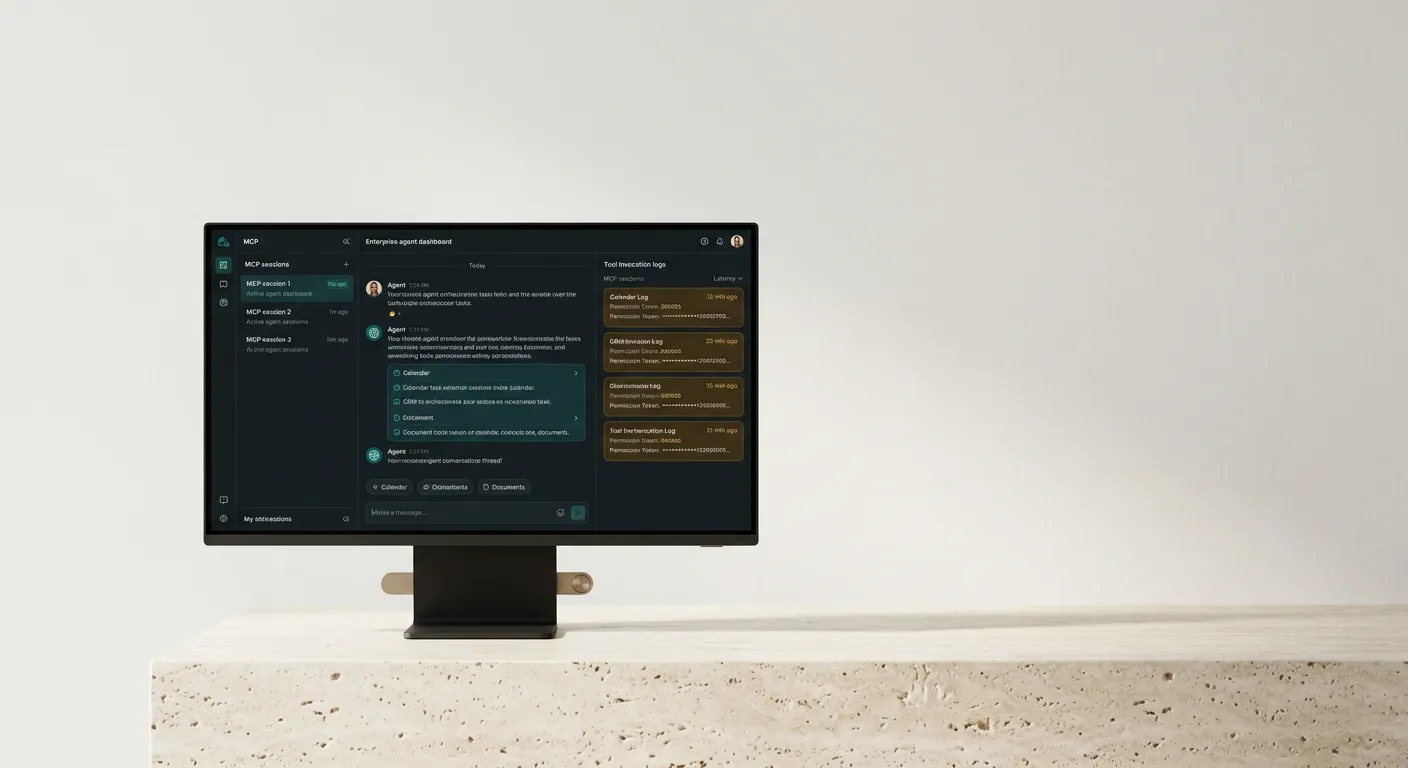
TL;DR
- GUI-dominant workflows are widely expected to decline as a share of daily enterprise interactions over the coming years as natural language becomes a more common entry point, based on the trajectory of platform roadmaps published by major model providers such as OpenAI and Google AI for Developers. Precise adoption timelines remain uncertain given the early stage of deployment.
- The Model Context Protocol (MCP) has emerged as a candidate standard for passing structured context, tools, and permissions between heterogeneous agents and models.
- Orchestration layers reduce “app fatigue” by eliminating the need to install and learn separate tools for the majority of routine cross-application tasks.
- Latency for complex agentic flows currently varies widely depending on model size and tool depth; cost per agent step remains significantly higher than traditional API calls.
- Determinism and auditability challenges persist, addressed in part through emerging explainability techniques.
- Security models are shifting from UI-level permissions to intent-based, revocable capability grants.
- Developer focus is moving from pixel-level UI design toward capability exposure, schema definition, and orchestration logic.
Mini Glossary
- LLM as operating system — Conceptual treatment of a large language model as the core execution environment that schedules, interprets, and coordinates software resources in response to natural language directives.
- Natural Language Interface (NLI) — Any primary interaction model where users express intent via text or voice rather than clicking, dragging, or selecting from predefined options.
- Agentic AI architecture — Systems composed of one or more autonomous agents that decompose goals, plan action sequences, invoke tools, and handle error recovery with minimal human supervision.
- Model Context Protocol (MCP) — An emerging interoperability specification defining standardized formats for sharing context, available tools, authentication state, and execution history between models and external services (modelcontextprotocol.io).
The Death of the GUI — and What Replaces It
The graphical user interface solved the accessibility problems of command-line computing but introduced its own constraints. Every feature must be discovered, every workflow anticipated by designers, and every integration requires users to act as the glue between applications.
Modern knowledge workers switch between dozens of applications daily, each with its own data model, authentication scheme, and interaction patterns. The cognitive overhead of context switching has become a primary productivity limiter. Natural language interfaces collapse this complexity by allowing users to state outcomes rather than specifying the exact sequence of clicks required to achieve them.

Early precursors existed in voice assistants, but these were limited to narrow domains and brittle scripts. Contemporary systems leverage foundation models trained on vast corpora of code, documentation, and interaction traces. When a user says “update the project budget to reflect the new vendor contract and notify stakeholders of variances over 5%,” the system can identify relevant documents, parse contractual terms, modify structured data, generate notifications, and log the changes for audit.
This capability does not eliminate visual interfaces entirely. Complex data exploration, creative design, and certain approval workflows still benefit from direct manipulation. Yet the primary mode of interaction is shifting. Google DeepMind research into agentic systems and Anthropic’s computer-use demonstrations illustrate how models can both consume and generate actions on existing interfaces — effectively using GUIs as a backend rather than a primary surface.
The change mirrors previous abstraction leaps. Just as assembly gave way to high-level languages and monolithic applications gave way to microservices, the user layer is being abstracted behind an intent interpreter. Related explorations of these architectural patterns appear in multi-agent orchestration for enterprise control planes.
The Architectural Shift: From CPU-Centric to Model-Centric
Traditional operating systems are built around the CPU as the primary execution unit. The kernel manages process scheduling, memory allocation, file systems, and device drivers. User applications request services through system calls.
In the emerging model-centric architecture, the LLM assumes the kernel role for the interaction and orchestration layer. It receives a high-level goal, decomposes it into steps, determines which capabilities — tools, APIs, data sources — are required, invokes them in sequence, synthesizes intermediate results, and presents a coherent response. The underlying compute, storage, and application services remain, but the model becomes the stable abstraction that developers and users program against.
Where CPU-centric systems optimize for deterministic, low-latency operations on well-defined data structures, model-centric systems optimize for semantic understanding and flexible composition. The “system calls” become natural language instructions or structured tool invocations passed via protocols such as MCP.
Repositories on GitHub already contain early implementations of agent runtimes demonstrating this pattern. Models are given access to tool definitions described in JSON schema or OpenAPI specifications. The model then decides the sequence and parameters for calling those tools, much as a kernel decides which processes receive CPU time.
The shift also affects data flow. Instead of applications owning siloed databases, knowledge is increasingly represented in shared graphs or vector stores that agents can query semantically. Work on RAG 2.0 and knowledge graph integration provides foundational patterns for making enterprise data available to these new kernels.
Interoperability and the Model Context Protocol
Heterogeneous models and tools create a combinatorial explosion of integration points. The Model Context Protocol attempts to address this by defining a common language for describing available capabilities, current context, authentication state, and execution history.
MCP messages contain structured sections for current user intent and conversation history, available tools with input/output schemas, active permissions and resource constraints, previous action results and confidence scores, and model handoff metadata when switching between specialized agents.
By standardizing this exchange format, organizations can mix models from OpenAI, Anthropic, open-source offerings on Hugging Face, and domain-specific fine-tunes without rewriting orchestration code for each combination. Early adopters report that MCP can substantially reduce integration time for new tool additions, though the protocol remains in active development with competing proposals still circulating.
Analytical Table: Legacy Stack vs. AI-Native Stack
| Aspect | Legacy Stack | AI-Native Stack | Key Trade-off |
|---|---|---|---|
| Primary Interface | GUI (clicks, forms, menus) | Natural language + selective visualization | Expressiveness vs. precision |
| User Mental Model | Application-centric | Outcome-centric | Familiarity vs. flexibility |
| Integration Method | Point-to-point APIs, manual workflows | Agent orchestration via MCP | Control vs. speed of composition |
| Developer Focus | UI/UX design, frontend frameworks | Tool schema design, evaluation harnesses | Visual polish vs. capability depth |
| Permission Model | Role-based access at UI/API level | Intent-based, revocable capability grants | Simplicity vs. granularity |
| Cost Structure | Predictable per-user licensing | Variable based on token usage and tool calls | Budget certainty vs. usage efficiency |
| Determinism | High (same input → same output) | Probabilistic with guardrails | Reliability vs. adaptability |
The AI-native approach trades certain guarantees for dramatically improved composability and reduced user training time. Organizations must evaluate which workloads benefit most.
The End of App Fatigue: Orchestration Over Installation
In a language-first world, the distinction between applications blurs. Instead of installing a dedicated expense reporting app, users instruct their agent to “process receipts from my email, categorize according to our policy, and submit for approval.” The agent discovers relevant services through registry mechanisms, requests necessary permissions, and completes the task.
This model favors capability providers over full-stack application vendors. A payment processing service no longer needs its own polished UI — it simply needs to expose clean APIs and MCP-compatible tool descriptions. Users discover and use capabilities through their primary conversational interface.
The pattern aligns with broader real-world asset tokenization infrastructure where standardized interfaces allow seamless composition across domains.
Technical Constraints: Latency, Cost, and Determinism
Despite rapid progress, significant constraints remain.
Latency. Simple queries have reached sub-second levels on optimized models, but complex agentic flows involving multiple tool calls and reflection steps can take noticeably longer. This makes the model unsuitable for real-time control loops without careful architectural design.
Cost. While per-user licensing offers predictability, token-based pricing scales with complexity. A sophisticated analysis task might consume thousands of tokens and multiple tool calls, creating variable monthly spend that requires new governance approaches. Current pricing details are published on provider pages such as OpenAI and Google AI for Developers.
Determinism. Small changes in prompt phrasing or model temperature can produce different tool selection sequences. Production systems address this through structured output modes, multiple verification agents, and human-in-the-loop escalation paths for high-stakes decisions. Auditable AI explainability techniques are becoming essential infrastructure for addressing these limitations in regulated industries.
Security and Permissions in a Language-First World
Traditional security models rely on clear boundaries between applications. In an agentic system, a single conversational session may span multiple tools, data sources, and even external organizations.
The new model requires capability-based security where permissions are granted at the level of specific actions rather than broad application access. A user might authorize an agent to “read calendar but not modify” or “access only non-PII customer data.” The MCP specification includes provisions for capability tokens that can be delegated, time-boxed, and revoked.
However, the semantic nature of requests creates new attack surfaces. Prompt injection remains a concern, as does the possibility of an agent being tricked into misusing granted capabilities. Organizations are adopting multi-agent architectures where a supervisor agent with strict controls oversees specialized worker agents with limited permissions — a pattern drawing on research into structured verification. Safety research published by Anthropic and Google DeepMind continues to inform best practices for mitigating these risks.
The Developer’s New Role
The shift changes what software creators focus on. Rather than designing intricate interfaces, developers must expose capabilities through clean, well-documented APIs and tool schemas; define clear input/output contracts that agents can reliably use; create evaluation datasets that test agent performance on their domain; and implement appropriate guardrails and logging for auditability.
The term “prompt engineer” understates the sophistication required. Effective practitioners combine systems thinking, domain expertise, and understanding of model behavior. They design workflows rather than screens. Open-source tooling on GitHub and model repositories on Hugging Face are accelerating this transition by providing reusable agent frameworks and pre-built tool integrations. This evolution is explored in discussions of the pivot from AI copywriter to AI workflow architect.
Conclusion: The Invisible Interface
The most successful interfaces eventually become invisible. We no longer celebrate the keyboard or mouse — they are simply there. The same fate awaits the GUI for many tasks. In its place will be a conversational surface that understands context, maintains memory, and acts with appropriate agency.
This future requires mature protocols like MCP, robust security models, new developer practices, and careful attention to the remaining technical constraints. Organizations that begin experimenting with language-first architectures today will be better positioned as the technology matures.
The LLM kernel represents not just a new interface but a new computing paradigm — one where intent, not clicks, drives digital work.
Frequently Asked Questions
What is the difference between an LLM acting as a kernel versus simply being a chatbot frontend?
The kernel role implies the model is responsible for resource scheduling, tool selection, state management, and execution orchestration across the software ecosystem. A chatbot frontend typically only generates text responses. The kernel pattern involves actual invocation of external systems with persistent context and permission controls.
Will MCP become the universal standard for agent interoperability?
While MCP has gained significant traction, competing proposals exist. Adoption by major providers — including those building on platforms documented at OpenAI and Google AI for Developers — will determine its longevity. Current implementations are compatible with Hugging Face models through community adapters.
How do organizations address the non-determinism of LLM-based systems in regulated environments?
Common approaches include structured output modes, multiple parallel agents that cross-verify results, comprehensive logging of reasoning traces, and human oversight for high-impact decisions. Research from Anthropic and Google DeepMind continues to improve consistency through better training and inference techniques.
Does this mean the end of traditional software development roles?
No. Roles evolve. Demand increases for those who can design reliable tool interfaces, create evaluation frameworks, implement security controls for agents, and architect orchestration layers. Traditional backend and infrastructure skills remain essential; the surface area of work simply moves upward in the stack.
What are realistic first use cases for enterprise adoption?
Internal knowledge management, meeting summarization with action item tracking, routine data analysis and reporting, IT support triage, and structured document processing show the strongest early results. These domains balance complexity with clear success criteria and manageable risk.